SocialUsage analysis of Pew Research Center
The U.S. platform age gap, in three comparisons
The distance between younger and older adults varies by platform. Six estimates from one survey make that difference visible.
Data through 18 June 2025 · Analysis published 1 October 2026
separate reported Instagram use among U.S. adults aged 18–29 and those aged 65+: 80% versus 19%.
U.S. adults in each age group · Self-reported ever use · February 5–June 18, 2025
SocialUsage calculation: 80 − 19 = 61 percentage points. Source: Pew Research Center, Social Media Fact Sheet, AGE table. All adults in each age group, including non-internet users.
Same age groups. Different gaps.
Percentage reporting ever use among ages 18–29, minus the percentage among ages 65+. A larger bar means a larger descriptive difference between these two groups.
SocialUsage analysis of Pew Research Center’s 2025 U.S. adult survey, February 5–June 18. Based on published whole-percentage ever-use estimates for ages 18–29 and 65+. These are three selected platform comparisons, not a ranking of every platform or a significance test.
View the exact inputs and calculation table
| Platform | 18–29 (%) | 65+ (%) | Difference (pp) |
|---|---|---|---|
| 80 | 19 | 80 − 19 = 61 | |
| 48 | 6 | 48 − 6 = 42 | |
| YouTube | 95 | 64 | 95 − 64 = 31 |
Source: “Who uses each social media platform?” AGE table, 2025, ages 18–29 and 65+. The calculations subtract rounded published estimates; pp means percentage points.
A gap and an adoption level answer different questions
YouTube has the smallest age gap among these three selected comparisons, alongside the highest reported use in both groups: 95% among ages 18–29 and 64% among ages 65+. Instagram’s larger gap comes from 80% and 19%; Reddit’s comes from 48% and 6%.
A gap alone does not tell you how widely a platform is used. Read it alongside the two source percentages and the population each percentage describes.
These findings compare different groups of adults at one point in time. They do not establish that age causes platform use or predict what today’s younger adults will do as they grow older. We have not tested whether the gaps differ significantly from each other.
Source for the six estimates: Pew Research Center’s 2025 AGE table. Differences and interpretation are SocialUsage’s analysis.
Reproduce the finding
Calculation steps and source identifiers
- Open Pew’s Social Media Fact Sheet and find “Who uses each social media platform?”
- Read the 2025 AGE values for Instagram, Reddit and YouTube in the 18–29 and 65+ columns.
- For each platform, subtract the 65+ percentage from the 18–29 percentage. For example, 80 − 19 = 61 percentage points for Instagram.
- Retain the survey, fieldwork dates, population and ever-use definition when citing the result. Do not label it percent growth.
Analysis release: us-age-gaps-2026-10-01. Source records: editorial-2026-09-30, retained within collection editorial-2026-10-01. Logical input IDs below are assigned by SocialUsage; they are not Pew-issued identifiers.
| Platform / source item | Ages 18–29 input ID | Ages 65+ input ID |
|---|---|---|
| Instagram / IG | pew-npors-2025-IG-age-18-29 | pew-npors-2025-IG-age-65-plus |
| Reddit / RD | pew-npors-2025-RD-age-18-29 | pew-npors-2025-RD-age-65-plus |
| YouTube / YT | pew-npors-2025-YT-age-18-29 | pew-npors-2025-YT-age-65-plus |
Each stored derivation records both input values, the original editorial record paths, source item, source record release and subtraction. The report build validates those inputs against the attributed source records.
Survey question, methods and uncertainty
The online-administration question was: “Please indicate whether or not you ever use the following websites or apps.” Online-administration wording for SMUSE. The question was asked of internet users; the cited topline rebases estimates to all adults. Paper and phone wording can differ slightly.
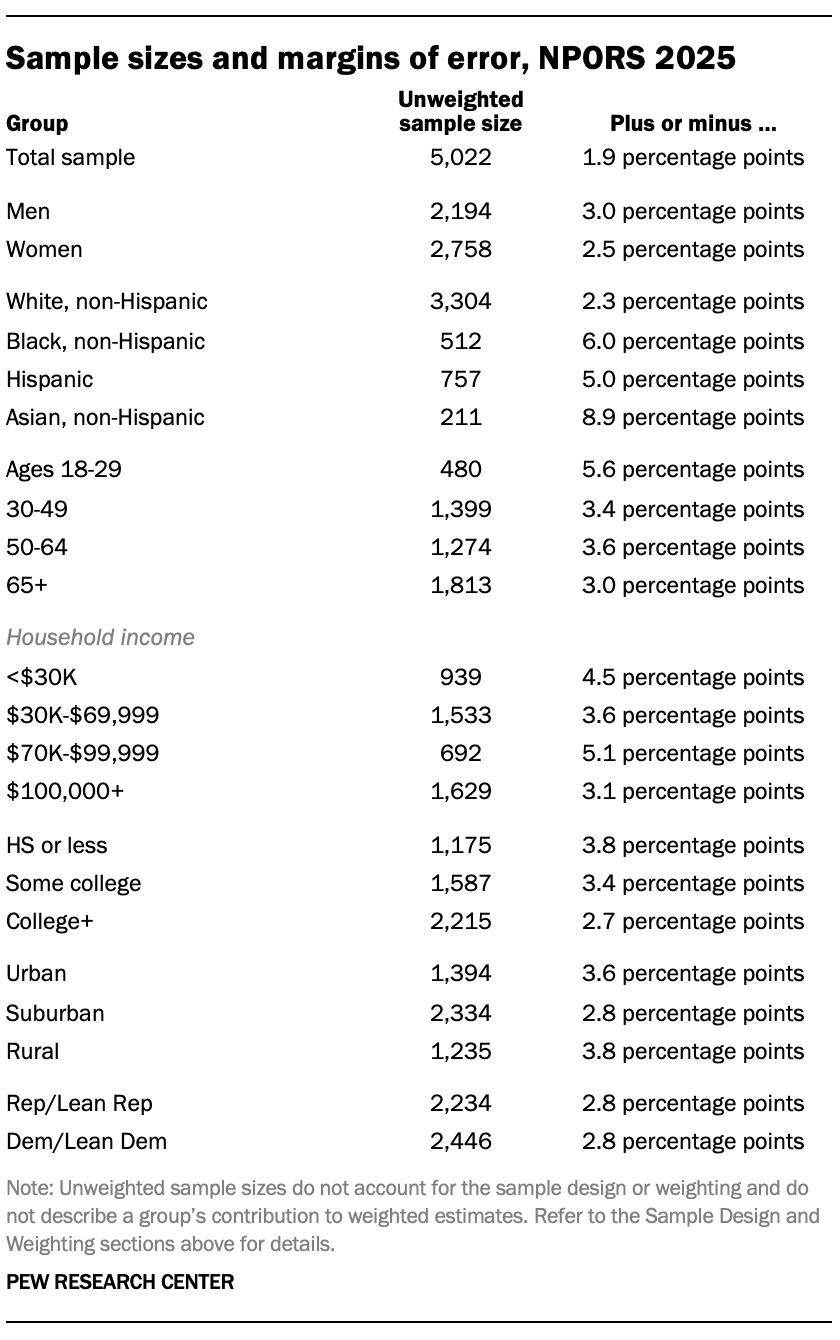
SSRS conducted Pew Research Center's 2025 National Public Opinion Reference Survey using address-based sampling and web, mail and telephone responses. Results are weighted to the U.S. adult population. The full sample was 5,022 adults; the two age groups included 480 respondents aged 18–29 and 1,813 aged 65+, before weighting.
Pew reports a 95% margin-of-error benchmark of ±1.9 percentage points for full-sample estimates at 50%. Its published age-group benchmarks are ±5.6 points for ages 18–29 and ±3.0 points for ages 65+. These are not platform-specific confidence intervals. Sampling error does not cover all possible survey error.
Subtracting published estimates does not produce a confidence interval for the difference. This analysis does not calculate one or test significance. It also does not measure daily or monthly activity, time spent, global platform audiences or teen use.
Pew methodology · Questionnaire and topline · Sampling-error benchmarks
Dates, review and reuse rights
Fieldwork ran February 5–June 18, 2025. The source was published on 20 November 2025. These six estimates were retrieved and checked on 30 September 2026. This analysis was published and its calculations checked on 1 October 2026.
This is an assisted descriptive analysis. Source-record compatibility and subtraction are checked during the build; independent human editorial review has not been recorded.
This page uses limited attributed editorial excerpts. We do not offer a Pew CSV, source graphic or chart download. Public availability of the original report does not make it an unrestricted dataset.
Pew Research Center’s terms · SocialUsage source and rights register
Pew Research Center bears no responsibility for the analyses or interpretations of the data presented here. The opinions expressed herein, including any implications for policy, are those of the author and not of Pew Research Center.
Common questions
Why are these gaps in percentage points?
A percentage-point gap subtracts two percentages directly. Instagram’s 80% minus 19% is 61 percentage points. It is not a 61% increase, and these different age groups do not form a growth series.
Is Instagram the platform with the biggest age gap?
It has the largest numerical gap among the three selected comparisons on this page. We have not reproduced all of Pew’s platform estimates, so this report does not support a claim about every platform. The ordering also does not establish statistical significance.
Can these age groups stand in for generations or teenagers?
No. The source groups are adults aged 18–29 and 65+. Relabelling them as teenagers or as named generations changes the population and can misrepresent the evidence.