Platform brief · United States
YouTube statistics
How many U.S. adults use YouTube?
Data through 18 June 2025
of U.S. adults say they ever use YouTube.
Adults aged 18+ · Self-reported ever use · February–June 2025
Source: Pew Research Center, Social Media Fact Sheet, “Which social media platforms are most common?” · 2025 row. The denominator is all U.S. adults, including non-internet users.
Within the same survey
Use across two age groups
Reported use is 31 percentage points higher among adults aged 18–29 than among those aged 65+.
Source: Pew Research Center, “Who uses each social media platform?” AGE table. Share of all U.S. adults in each age band who ever use YouTube; February–June 2025.
View the data table and calculation
| Age group | Share | Unweighted subgroup n |
|---|---|---|
| 18–29 | 95% | 480 |
| 65+ | 64% | 1,813 |
SocialUsage calculation: 95 − 64 = 31 percentage points, using rounded published estimates.
YouTube use was reported by 95% of adults aged 18–29 and 64% of adults aged 65+ in the same survey. The resulting 31 percentage point difference is SocialUsage's calculation from rounded source figures. Substantial adoption in both age groups does not reveal whether their viewing frequency or content preferences are alike.
This describes a difference between age groups. It is not a measure of growth or a test of statistical significance.
About this finding
What “ever use” means
Weighted share of all U.S. adults who report ever using the named website or app. This measure does not establish daily or monthly activity, number of accounts, advertising reach, or a global user count.
Published question: “Please indicate whether or not you ever use the following websites or apps.”
Online-administration wording for SMUSE. The question was asked of internet users; the cited topline rebases estimates to all adults. Paper and phone wording can differ slightly.
Original question and denominator: 2025 survey topline, SMUSE (PDF).
Survey methods and uncertainty
SSRS conducted Pew Research Center's 2025 National Public Opinion Reference Survey using address-based sampling and web, mail and telephone responses. Results are weighted to the U.S. adult population.
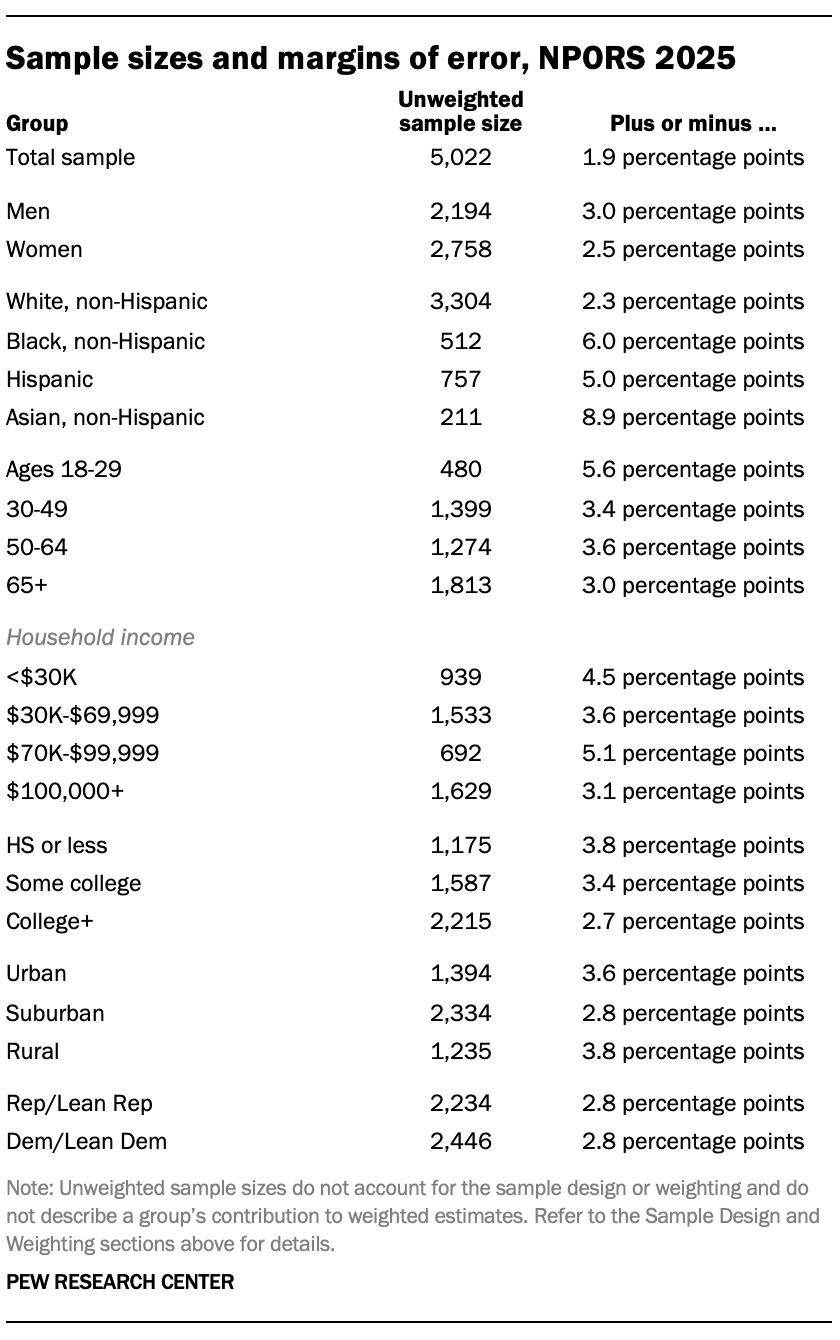
Fieldwork: February 5–June 18, 2025. Results are weighted to U.S. adults; the unweighted sample is 5,022.
Pew reports a 95% margin-of-error benchmark of ±1.9 percentage points for full-sample estimates at 50%. Its published age-group benchmarks are ±5.6 points for ages 18–29 and ±3.0 points for ages 65+. These are not platform-specific confidence intervals. Sampling error does not cover all possible survey error.
Pew’s full survey methodology · Published sample and margin-of-error table
- Self-reported ever use is broader than daily or monthly active use. It does not tell us how often an individual uses the platform.
- The population is U.S. adults. These results do not describe teenagers, other countries, or the global platform audience.
- Age differences describe groups at one point in time. They do not establish that age causes usage, or predict how an individual will behave as they get older.
- Survey modes changed from phone before 2023 to web and mail in 2023, then web, mail and phone in 2024–2025. Do not treat the full historical series as an unchanged measurement process.
Publication dates, evidence review and reuse
- Survey period
- February 5–June 18, 2025
- Source published
- 20 November 2025
- Retrieved
- 30 September 2026
- Evidence checked
- 30 September 2026
- Editorial release
- editorial-2026-09-30
Source extraction cross-checked against the published topline and methodology; no independent human review claimed.
Limited attributed editorial excerpt under Pew Research Center's Terms of Use, sections 1–3. Do not mirror or republish the source in principal part. This release does not redistribute survey files, source graphics, or a Pew CSV.
Pew Research Center terms. Pew Research Center bears no responsibility for the analyses or interpretations of the data presented here. The opinions expressed herein, including any implications for policy, are those of the author and not of Pew Research Center.
Common questions
Does this mean 84% use YouTube every day?
No. The survey asks whether people ever use the service. It does not establish how frequently they use it. A daily or monthly active-user figure answers a different question.
Understand the different user measuresIs this YouTube’s worldwide audience?
No. These estimates describe adults aged 18 and older living in the United States, including ages 18–19. They do not estimate teenagers as a separate group, cover other countries, or count accounts on the platform.
Can I combine this with other platform percentages?
No. The same person can use several platforms. Adding their adoption percentages would count some people more than once and would not estimate unique social-media users.